Jul 01, 2026•4 min read•
Mochi: The Story Behind Japan’s Beloved Snack
Discover mochi, Japan’s famous “rice cake”. Learn what mochi means, how it’s made and why it remains culturally significant.
People are often surprised the first time they try mochi (餅). It looks simple enough, a small, smooth ball of pounded rice, often dusted with starch and filled with something sweet. Yet the texture is unlike anything found in Western cuisine. Soft, stretchy and remarkably chewy, mochi has a way of defying expectations.
Its distinctive texture has helped make mochi a global phenomenon that can now be easily found outside of Japan, including the freezer aisle of many supermarkets! While mochi is often sold as a novelty snack in Western countries, this sweet treat has a rich history rooted in Japanese culinary tradition.
In Japan, mochi has been enjoyed for more than a thousand years. It has played a role in religious ceremonies, seasonal festivals and family celebrations, carrying cultural significance that extends far beyond its ingredients. Understanding mochi means understanding not only what it is made from, but the customs and values that have shaped its place in Japanese culture.
What Does Mochi Mean?
A simple Japanese-to-English translation would render the word ‘mochi’ as ‘rice cake’. While technically correct, the translation only tells part of the story. For many English speakers, a rice cake is a light, crunchy snack made from puffed rice. Mochi, by contrast, is soft and chewy, traditionally made by pounding glutinous rice into a smooth, elastic paste.
This difference highlights an important challenge in translation. Finding an equivalent word is often only the first step. Translators must also consider the cultural associations, expectations and experiences that audiences bring to a term. Food provides some of the clearest examples of this challenge. Japanese food terms are complex, and while literal translations may convey a basic meaning, they often struggle to capture a dish’s culinary traditions and cultural significance.
This is why localisation, and Japanese localisation in particular, often involves more than replacing words from one language with another. Effective communication requires an understanding of the cultural context behind those words, helping audiences appreciate not just what something is, but what it means.
What may seem like little more than a chewy sweet on the surface carries associations with celebration, good fortune and the changing of the seasons that many international consumers don’t realise.
A Food Shaped by Tradition
Historical records suggest Japanese people have been eating mochi since the 8th century (the Heian period), when it was associated with celebrations, religious ceremonies and offerings to the gods. Over time, it became closely linked with ideas of prosperity, good fortune and longevity.
One of mochi’s most important associations is with the Japanese New Year, known as oshōgatsu (お正月). During this period, many families display kagami mochi (鏡餅), decorative stacks of mochi that symbolise renewal and good fortune for the year ahead. Mochi is also commonly eaten during New Year celebrations, reflecting its long-standing connection to important milestones and seasonal traditions.
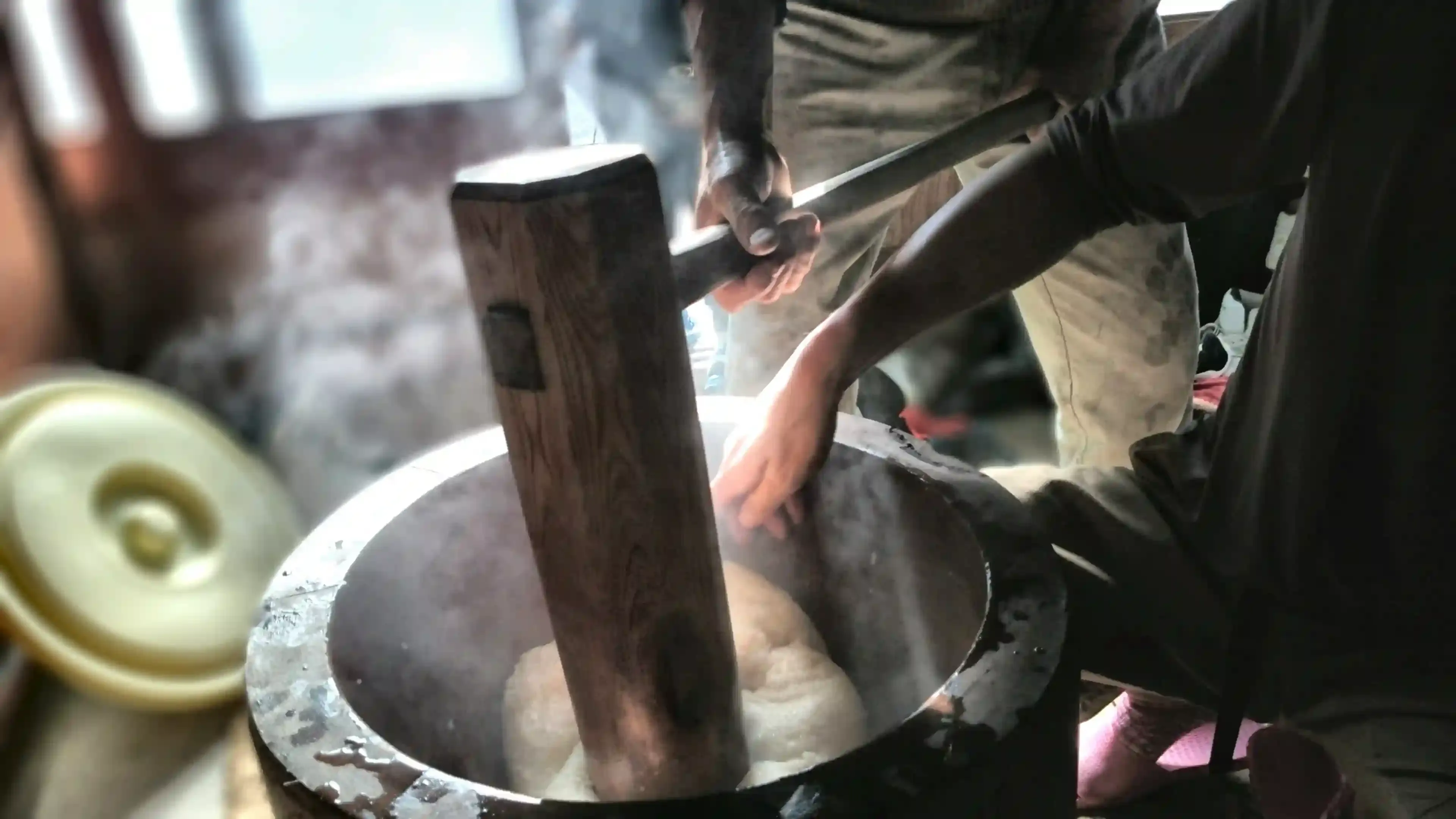
The preparation of mochi has traditionally been just as significant as eating it. In many communities, families and neighbours gather for mochitsuki (餅つき), the process of pounding steamed rice into mochi using a large wooden mallet and mortar.
The teamwork involved has made mochitsuki as much a social and cultural event as a culinary one. While modern machinery has simplified production, mochitsuki demonstrations and community events remain popular across Japan. For many people, mochi continues to represent family, tradition and a connection to the past, which helps explain its enduring place in Japanese culture.
From Tradition to Global Trend
Outside Japan, people tend to think of mochi as a single food, when it's actually available in a wide variety of forms, flavours and textures. Traditional examples include daifuku (大福), which is typically filled with sweet red bean paste, and sakuramochi (桜餅), a springtime speciality wrapped in a pickled cherry blossom leaf. Other varieties, such as kusa mochi (草餅), incorporate ingredients like Japanese mugwort to create distinctive flavours and colours.
Mochi’s growing popularity beyond Japan has led to new interpretations, with mochi ice cream among the most successful. Naturally, as it’s travelled, its meaning has shifted. For many, mochi is a novelty dessert or part of a wider health-food trend, and is often discovered on social media. In these contexts, the seasonal customs and ceremonial traditions that helped shape its development are often overlooked, but that’s not necessarily a bad thing.
Cultural exchange has always involved adaptation, and mochi’s growing popularity has introduced Japanese cuisine to audiences who may never have encountered it otherwise. The same phenomenon can be seen in literature and even board games, where local tastes, expectations and cultural references often influence how a product is presented in a new market. Yet it is worth remembering that behind the latest flavour or viral trend lies a food with centuries of history and cultural significance.
Whether enjoyed at a New Year celebration in Tokyo or as a dessert in London, the same texture that has fascinated people for centuries continues to captivate people around the world.
Despite the countless ways mochi has been adapted, flavoured and reinterpreted, the experience remains remarkably consistent. People still pause at that first bite, trying to make sense of a texture that’s unlike anything they expected. In a world where food trends come and go, there is something remarkable about a tradition that can still surprise people after a thousand years.
Categories
- Japanese Language and Culture
- Marketing and Japanese Language