Sep 09, 2026•5 min read•
Digital Watermarks in AI-Generated Text: What Happens After Translation?
A digital watermark can identify AI-generated text — but does it survive translation? Learn how text watermarking works and why it matters.

Watermarks are often used to prove ownership and deter copyright infringement. As AI-generated content becomes increasingly common, however, they’re taking on another important role: establishing provenance — who created something, where it came from and whether it’s authentic.
As generative AI becomes more widely used for content creation, digital watermarking is emerging as one way to identify AI-generated material and trace its origins. For businesses producing content across multiple markets, however, this raises an important question.
What happens to an invisible watermark when the text carrying it is translated into another language? And can businesses still rely on that watermark once content has passed through a multilingual workflow?
What is a digital watermark?
A digital watermark is information embedded into content to help identify its source, ownership or authenticity. Like a physical watermark, it can indicate origin, but it can be applied to everything from images and video to audio and text.
While many digital watermarks are visible, such as a photographer’s logo placed over an image, others are invisible and only detectable by software. AI watermarking applies the same broad principle to AI-generated content. With text, however, there may be no hidden logo, metadata or secret string of characters to find. Instead, the watermark can be encoded in how the text itself is generated.
How does AI text watermarking work?
Generally speaking, Large Language Models (LLMs) generate text by predicting what should come next, one token at a time. A token might be a whole word, part of a word or even a single character. At each stage, the model considers a range of possible tokens and assigns each one a probability based on how likely it is to be an appropriate choice.
Text watermarking can subtly influence these probabilities, making certain choices slightly more or less likely. The individual choices still appear natural to the reader, but across a longer piece of text they create a statistical pattern that specialised software can detect.
Google’s SynthID, for example, uses this approach to watermark text generated by Gemini. The watermark is therefore not a hidden message that can simply be found within the text. It’s a pattern created through the choices made while the text is being generated.
What happens to a digital watermark during translation?
If a text watermark is created through a pattern of word and token choices, translation presents an obvious challenge: those choices may no longer exist in the translated text.
Translation isn’t merely a process of replacing a word with its equivalent in another language. Sentence structure, word order and phrasing may all need to change to communicate the same meaning naturally. This is especially true when translating between languages as structurally different as English and Japanese. Not only can grammar and syntax be significantly different, but some words simply cannot be translated directly.
As a result, the pattern carrying a watermark in the source text may weaken or be lost completely during translation. A watermarked English press release, for example, might produce a perfectly accurate Japanese translation while no longer retaining enough of the original pattern for the watermark to be detected.
Research presented at the 2024 Annual Meeting of the Association for Computational Linguistics (ACL) examined this problem across several text watermarking methods and languages. The researchers found that translation can significantly reduce watermark detectability, though to what extent varies depending on the watermarking method and the translation process.
What about machine translation?
Machine translation (MT) adds another layer of complexity. Translating watermarked AI-generated content with an MT system can disrupt the original watermark, just as human translation can, because the target text uses new linguistic choices.
However, using generative AI for translation raises a separate question. If an AI system generates the translated output, any watermark applied to that output would relate to the system that produced the translation, rather than being carried over from the source.
Digital watermarking and the EU AI Act
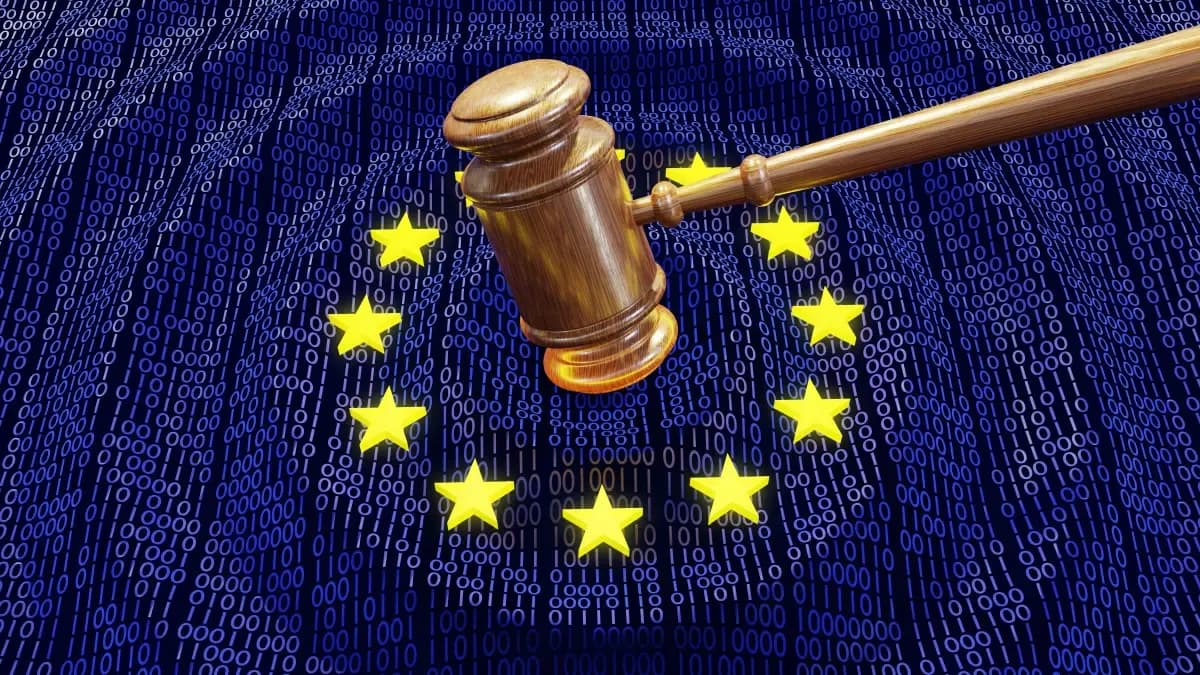
Regardless of its challenges, digital watermarking isn’t just a technical consideration; it’s also a compliance consideration. For example, the EU AI Act contains transparency requirements intended to make certain AI-generated and manipulated content identifiable as artificially generated, including through machine-readable methods.
Digital watermarks offer one approach, alongside techniques such as metadata and other methods of identifying AI-generated content. However, exactly how these requirements apply depends on the AI system, the content being produced and how that content is used.
The EU is not alone in introducing such measures. China has similar requirements for labelling AI-generated content, including both explicit labels visible to users and implicit identifiers that can be detected digitally.
For businesses creating and translating content across multiple markets, these developments add another consideration to multilingual workflows. If AI-generated content is subsequently translated, edited or localised, organisations may need to consider whether the method originally used to identify that content remains effective.
What does this mean for translation buyers?
Digital watermarks can provide useful information about how content was created, but they should not be treated as definitive proof that translated content is either AI-generated or human-written. A watermark may be weakened during translation or editing, while the absence of a detectable watermark does not necessarily mean that AI was not involved.
For translation buyers, this makes it important to understand where and how AI is being used throughout a multilingual workflow. This might include creating the source material, the translation process itself, or subsequent editing and localisation.
Crucially, identifying AI-generated content is also separate from assessing its quality. A digital watermark cannot determine whether a translation is accurate, uses the appropriate terminology or communicates naturally with its intended audience. Therefore, human review remains an important part of multilingual quality assurance, even if AI was used elsewhere in the process.
Ultimately, digital watermarks are a useful tool, but they’re far from foolproof. Businesses working across languages should make them part of a wider approach to AI transparency and multilingual content management — one that considers not only how content was created, but whether the final translation is accurate, appropriate, and fit for its intended audience.
At Word Connection, our experienced linguists combine language expertise with an understanding of the technologies shaping modern translation. Get in touch to discuss how we can support your multilingual content.
Categories
- Artificial Intelligence and Machine Translation
- Revision
- Digital Content