Jun 24, 2026•5 min read•
LocWorld55 Dublin 2026: AI Solved Scale. What About Quality?
AI has made localisation cheaper and faster and nobody at LocWorld55 could agree on whether it has made it better. Here is what the quality conversation actually revealed about the gap the industry still has not closed."
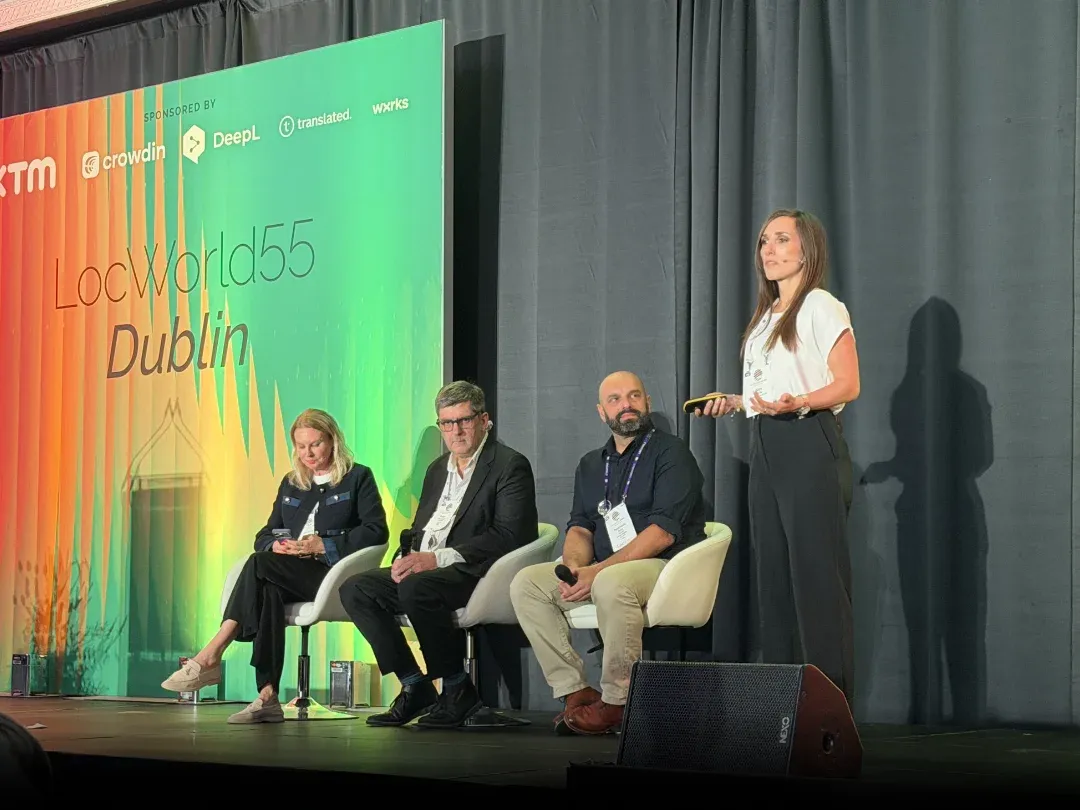
A lot has happened in the nine years since our team last attended a LocWorld conference. In that time, few developments have had as profound an impact on the localisation industry as the rise of artificial intelligence.
Unsurprisingly, AI dominated almost every conversation at LocWorld55 in Dublin earlier this month. But while much of the industry's attention remains focused on the technology itself, the conversations we found most interesting were about something else: quality.
AI has dramatically changed the economics of localisation and unlocked new levels of scale. Still, it has also raised an important question: how do you consistently deliver production-quality results within an AI-driven workflow?
That question surfaced again and again throughout the event. Not always directly, but through discussions about governance, orchestration, quality assurance and human oversight. And it may be the challenge that defines the next phase of localisation.

Scale Has Been Solved
For much of our industry's history, scale has been the greatest challenge. As businesses expanded into new markets and workloads increased, localisation teams were under constant pressure to deliver more translations, in more languages, faster and at lower cost.
Artificial intelligence has changed that equation. Throughout LocWorld55 Dublin, discussions regularly touched on workloads that would have been unrealistic just a few years ago. Tasks that once required significant human effort can now be completed in seconds, enabling organisations to localise more content than ever before.
However, while AI has expanded what is possible, operational processes have not always kept pace. Organisations still need content that is accurate, culturally appropriate, brand-aligned and fit for purpose. Producing large volumes of content is no longer the hard part. Ensuring that content consistently meets the standards expected by clients and end users is where the real challenge begins.
As a result, the industry’s focus seems to be shifting. The question is no longer whether localisation can scale, but rather how to govern that scale effectively.
Adding Quality to the Equation
The economics behind AI adoption are simple. If a technology can help organisations localise more content, in more languages, at lower cost, its widespread adoption is inevitable.
The difficulty is that quality doesn’t scale as neatly as volume.
At one end of the spectrum, fully automated workflows can process enormous amounts of content at remarkable speed. On the other hand, traditional human-led approaches remain the benchmark for high-quality output, especially with specialist topics and high-risk outputs. Many organisations now find themselves somewhere in between, trying to balance cost, efficiency and quality without compromising on any of them.
This balancing act surfaced repeatedly throughout LocWorld55 Dublin. The industry has largely accepted that AI is here to stay, but there is less consensus on how much human involvement is required, where it should be introduced, and who should be responsible for quality.
Perhaps that’s because there is no universal answer. The right balance will depend on the content, the audience and the level of risk involved. But if there was one theme that emerged from Dublin, it’s that quality cannot simply be assumed.
Same Questions, New Language
Another interesting trend we noticed at LocWorld55 was the terminology being used to describe people’s evolving roles and responsibilities.
Speakers and attendees spoke about “AI orchestration”, “governance layers”, and “human-in-the-loop workflows”. We also heard localisation providers described as “Language Solution Integrators” and linguists increasingly positioned as auditors, reviewers or quality specialists rather than traditional translators.
These terms reflect a growing recognition that localisation is changing. As AI takes on a greater share of content production, human expertise is increasingly applied elsewhere: reviewing outputs, managing risk, maintaining quality standards, and ensuring content remains fit for purpose.
At the same time, the emergence of this new vocabulary highlights an important reality. While the industry may be developing new ways to describe the problem, the underlying challenge remains largely unchanged. Organisations still need reliable methods for delivering quality at scale. Renaming roles may help define new responsibilities, but it does not remove the need for human knowledge and judgment.
Human Oversight Is Evolving, Not Disappearing
The rise of AI has sparked widespread speculation about the future of human involvement in localisation. Some see fully automated workflows, while others remain convinced that human expertise will remain at the centre of the process.
The reality is likely somewhere in between.
Throughout LocWorld55 Dublin, there was little evidence that human expertise is becoming less valuable. If anything, many of the conversations we had suggested the opposite may be true. The challenge is not whether humans remain involved, but where their involvement creates the greatest value.
Linguists are increasingly being asked to review, evaluate and guide outputs rather than translate everything from scratch. Their expertise is becoming more targeted, focusing on quality assurance, cultural nuance, specialist subject matter and risk management.
When it comes to regulated industries, specialist languages and high-stakes content where accuracy matters above all else, this becomes even more important. In these scenarios, human expertise remains a critical part of the localisation process, providing the oversight and accountability that AI alone cannot guarantee.
Why Quality May Favour Specialists
If there was one message that emerged from LocWorld55 Dublin, it was that AI alone is unlikely to be the differentiator for much longer. The technology is becoming increasingly accessible, and many organisations now have access to similar tools and capabilities. In this sense, AI is helping to level the playing field.
What will set providers apart is how they use those tools.
As workflows become more complex, the ability to combine technology with effective oversight, quality assurance and human expertise becomes increasingly valuable. Success depends not only on generating content at scale, but also on building processes that ensure content remains accurate, appropriate and fit for purpose.
This may create opportunities for smaller, specialist language service providers. While larger organisations benefit from scale, specialist providers are often closer to their clients, linguists, and subject-matter experts. This proximity can make it easier to embed quality in AI-enabled workflows from the outset.
As the industry continues to evolve, the organisations best positioned for long-term success may be those that can clearly demonstrate how quality is measured and maintained, rather than simply how quickly content can be produced.
The providers that succeed are unlikely to be those making the boldest claims about artificial intelligence, but rather those who can demonstrate how quality survives — and thrives — in the age of AI.
Categories
- Translation and Localisation
- Transcreation